Understanding Leather: What We Use at Atelier 1891 and Why It Matters
Buying leather shouldn’t feel like decoding a secret language.
Yet everywhere you look you’ll see words like full-grain, genuine, pull-up, vegetable-tanned, crazy horse. Some of them signal exceptional quality. Others are marketing shortcuts.
At Atelier 1891, we believe you deserve clarity.
Because leather is not just a material to us.
It is the foundation of heirloom pieces; objects that live with you, travel with you, and grow more beautiful with time.
Leather quality is determined by four different things:
Grade – Which layer of the hide is used
Type – The animal source (cowhide, buffalo, etc.)
Tanning – How the hide is preserved
Finish – How the surface is treated
These are not interchangeable terms.
You can have:
Full-grain (grade)
Vegetable-tanned (tanning)
With a pull-up wax finish (finish)
Each decision affects durability, aging, flexibility, and character.
At Atelier 1891, we choose deliberately.
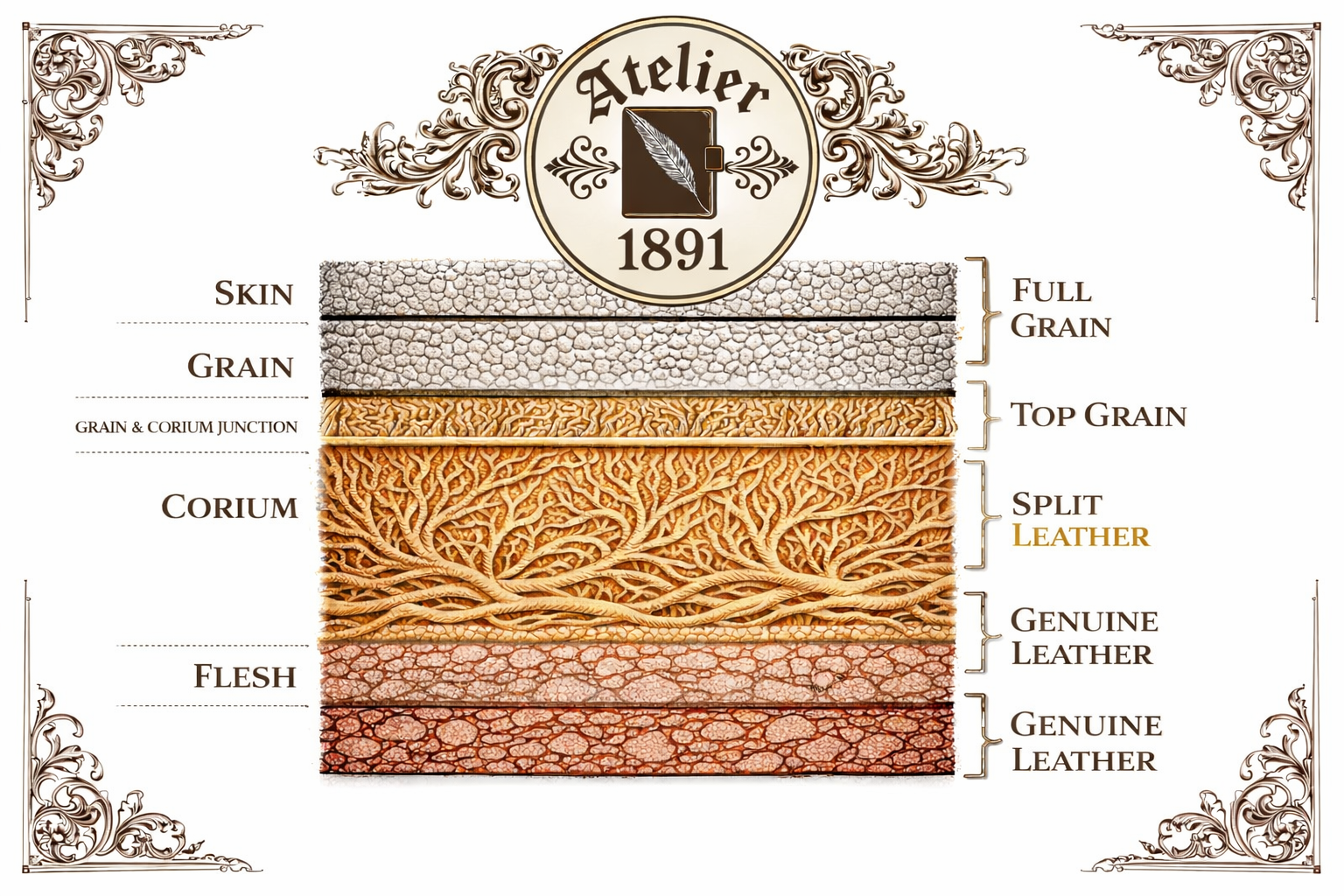
The Anatomy of Leather (Why the Top Layer Matters)
A hide is not uniform. It has structure.
The Grain (Top Layer)
The strongest, tightest fibers live here.
This is where full-grain leather comes from.
It resists wear.
It breathes.
It ages beautifully.
The Corium (Lower Fibers)
Looser structure.
Weaker tensile strength.
Often used for suede or lower-grade leathers.
When leather is “split,” the hide is divided horizontally. The top portion is strongest. The lower layers are less durable.
Understanding this alone explains most quality differences.
Leather Grades
1. Full-Grain Leather
This is the highest quality leather available.
It comes from the very top of the hide and keeps the natural grain intact — no sanding, no artificial correction.
You may see:
Small scars
Wrinkles
Natural color variation
Those are not flaws. They are proof of authenticity.
Why we choose it:
Exceptional strength
Ages into a rich patina
Develops character unique to the owner
Can last decades when cared for
Many of our Atelier 1891 covers are made from full-grain leathers sourced from respected tanneries around the world; including traditional American and European vegetable tanneries and specialty pull-up producers known for depth and richness.
If you want a piece that looks better in 10 years than it does today, this is the leather.
2. Top-Grain Leather
Still real leather. Still strong.
But the very top surface has been lightly sanded or refined for uniformity.
This creates:
A smoother appearance
Fewer visible natural marks
A more consistent finish
It is slightly less durable than full-grain because the strongest fibers are partially removed.
High-quality top-grain from a reputable tannery can still be excellent. Lower-quality versions may rely on heavy coatings to hide imperfections.
The difference lies in sourcing and we are selective.
3. Corrected or Embossed Leather
This begins as top-grain but is heavily sanded and stamped with an artificial grain pattern.
The result:
Very uniform
Very consistent
Often coated with pigments
It prioritizes appearance over natural aging.
It will not develop the same depth of patina as full-grain.
4. Split Leather (Including Suede)
When the top layer is removed, what remains is called split leather.
Suede is made from this underside.
It can be soft and beautiful but it does not have the same fiber density or long-term durability as top layers.
Split leather has its place. It is simply not built for rugged daily carry.
5. “Genuine Leather” A Misleading Term
This surprises many people.
“Genuine leather” sounds premium.
It simply means: this contains real leather.
It does not specify quality. It does not guarantee durability. It often refers to heavily processed lower split layers that are painted to look smooth.
If a product only says “genuine leather” and offers no additional detail, that is not transparency.
At Atelier 1891, we specify if genuine leather is used because details matter.
6. Bonded Leather & PU Vegan Leather
Bonded leather is made from scraps and dust mixed with adhesives and pressed into sheets.
It peels.
It cracks.
It does not age.
PU leather is plastic-based synthetic material. It can serve a fashion purpose, but it will never develop patina. It cannot be restored in the same way real leather can.
We do not use bonded leather.
We do not use synthetic substitutes.
Our philosophy is heirloom over trend.
What Is Pull-Up or “Crazy Horse” Leather?
Despite the name, it is not horse leather.
It is typically full-grain leather infused with waxes and oils.
When bent or scratched, the oils shift — creating lighter tones in the flexed area. This is called the pull-up effect.
Why we love it:
It develops depth quickly
Small marks blend with use
It tells a story immediately
It feels alive
Many of our most beloved Atelier 1891 pieces feature this finish because it reflects our philosophy: life leaves marks and those marks become beauty.
Tanning: Vegetable vs Chrome vs Combination
Tanning affects structure and aging.
Vegetable-Tanned
Traditional method using plant tannins
Firmer structure
Develops strong patina
Deepens in tone over time
We love vegetable-tanned leather for its heritage character and ability to truly become yours.
Chrome-Tanned
Softer and more flexible
Often more water-tolerant initially
Extremely common in modern goods
High-quality chrome-tanned leather from respected tanneries can be outstanding when properly finished.
Combination-Tanned
A blend of methods balancing structure and flexibility.
We select tanning methods intentionally based on how the leather will perform in a traveler's notebook, planner cover, or heirloom piece.
Finish: Aniline vs Pigmented
This determines how natural the leather appears.
Aniline
Minimal coating
Shows pores and markings
Strong patina potential
Semi-Aniline
Light protective layer
Balanced aging and protection
Pigmented
Heavier coating
More uniform
Less visible aging
We prefer leathers that breathe and evolve because our pieces are meant to live with you, not remain frozen in perfection.
So What Do We Use at Atelier 1891?
We source leathers from carefully selected tanneries known for:
Ethical production standards
Consistent fiber density
Rich dye processes
Depth of color
Long-term performance
Our leathers come from respected suppliers across the United States and Europe. Chosen not for trend, but for integrity.
Every hide is evaluated by hand.
Every cut is intentional.
Every piece is designed to age beautifully.
We build for decades, not seasons.
The Atelier 1891 Philosophy
We do not chase buzzwords.
We chase legacy.
We choose leathers that:
Deepen with time
Carry the marks of life gracefully
Can be restored, conditioned, and loved for years
Because an heirloom leather piece should not look its best the day you receive it.
It should look its best ten years later and even better 25 years later.
And that is the standard we build to.
If you ever have questions about a specific leather we are using, we will gladly tell you everything we know about it. Transparency is part of craftsmanship.
Welcome to the world of real leather, done properly.
— Atelier 1891
